 |
True Art long since moved out of the confines of the gallery, creating a schism between art that is truely contemporary, and the sanitized approximation of modern art, that the world of big gallery acceptance would have us believe is modern. Cosying up to rebellion and controversy can lead to much cachet. It can also backfire, as street art champion Jeffery Deitch director of LA’s Museum of Contemporary Art found this week, when he was forced to whitewash out a mural by Italian graffiti artist Blu. The giant mural featured rows of coffins with dollar bills attached to the lids. A yawn-some anti war protest that might not go down to well with MOCA’s big money sponsors and moneyed fine art clientele? A decision that I leave to the conscience of individual Juicelings. But big Jeff didn’t take any chances, and the offending work was painted over quicker than an unsavory epithet scrawled with a sharpie on one of MOCA’s restroom walls. According to Marcel Duchamp, ‘All art must shock and provoke thought.’ fine words from the creator of the signed latrine and the godfather of the prototypicaly rebelious Dada movement. A sentiment that certainly applies to the work by Blu. But do we really want to be shocked and provoked all the time? Do we care about political cliche writ large on the gallery wall? The real statement here is of course the disrespect and the metaphorical wedgie that Blu has pulled on MOCA and Deitch, who has only made things worse for himself by claiming the mural might upset Japanese American veterans and that Blu can return to paint another (presumably less controversial) mural if he likes. Oh dear, it would seem big Jeff and MOCA’s David Geffen wing aren’t quite as hip as they thought they were after all. |
Menorah be the one
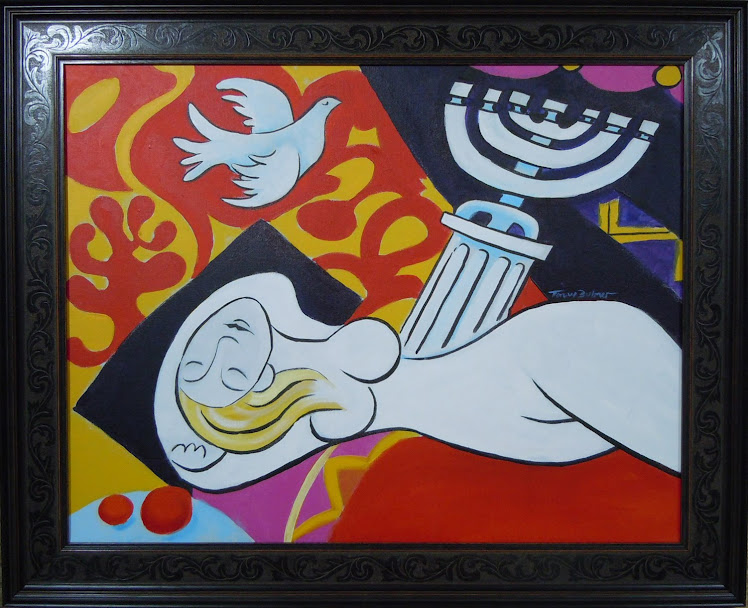
Menorah be the one. artbytonybulmer.com
Tuesday, December 14, 2010
Blu Whitewash

Tuesday, December 7, 2010
Picasso art hoard sparks controversy
 It’s hard to find good help these days. Overcharging, shoddy workmanship and all manner of service sector shennanigans lay in wait anyone foolish enough to invite the modern tradesperson over their threshhold. It is therefore vital to use trusted and well referenced help when planning home improvements. The wheels of commerce should always be well oiled with cash tips, the occasional bottle of good quality booze and perhaps a brace of partridges from the country estate, when season or occasion demands it.
It is therefore understandable that Claude Picasso was some what surprised to learn that the families former electrician Pierre Le Guennec, 71 of the French Riviera town Mouans-Sartoux, has come forward with 271 works by Pablo Picasso claiming that Jacqueline Picasso the great artists final wife had bestowed the works on him as thanks for his deft wiring skills.
Le Guennec, Picasso's electrician between 1970 and 1973, had been storing the pieces in his garage, The works including watercolors, sketches and collages date back to the period between 1900 and 1930,
"It was madame who gave them to me, because she was pleased with my service," claimed the tousel haired codger, who also appears to be a collector of plaid shirts. At a present day value of $79 million, that is quite some tip from Madame Picasso. French culture is naturally socialist minded of course and this egalitarian gesture is to be commended. Sadly, Jacqueline Picasso passed away in 1986, so confirmation of the legitimacy this generous gift may be hard to come by.
Le Guennec presented the works to the artists estate for authentication in September. The estate much surprised at the reemergence of such a large quantity of work once thought destroyed, claimed theft and sued for possession. The works were seized last month by the Office Central de Lutte contre le Trafic de Biens Culturels, the French art-trafficking squad. Perhaps we should look out for the opening of yet another Picasso Museum? Watch this space.
Wednesday, November 10, 2010
$42m for a Lichtenstein? Ohhh…Alright…

A Roy Lichtenstein painting previously owned by billionaire money bags and sharp elbowed art fancier Steve Wynn made $42.6 million at Christie’s International today.
Titled “Ohhh ... Alright...’’ (1964) this classic Lichtenstein represents Pop Art iconography at it’s most alluring.
The picture topped out the current $16.3 million auction record for the artist.
The Christies New York sale of contemporary and post-war in art achieved $272.8 million in sales. confirming a growing belief that the art market is heading out of the recession.
The picture topped out the current $16.3 million auction record for the artist.
The Christies New York sale of contemporary and post-war in art achieved $272.8 million in sales. confirming a growing belief that the art market is heading out of the recession.
Warhol, Liz Taylor and a drunken night out with Hugh Grant

Grant ordered an underling to bid for the painting at an auction in New York, after indulging in a two-day drinking spree—never expecting the bid to succeed. When he sobered up, he discovered to his horror that he was the proud owner of a multi million dollar painting.
Grant sold the painting in 2007 for the vastly inflated price of $20.8 million. ‘I slightly regret selling it now, even though it made me rich.’ confessed the actor with characteristic sheepishness.
Warhol is a master of the ironic flourish and the commoditization of popular culture, however Juicelings may notice in the above painting a more than passing resemblance to Batman nemesis. The Joker. Intention or happen-chance? Discuss.
$35 Million for a Coke?

Tuesday, November 9, 2010
Jerry Robinson Legend

There has been much talk in Creative Juicings lately over the price of art. If it is return on investment you are looking for, it is perhaps the Golden age of Comics you should be looking to. Just as the work of artists such as Titian and Picasso define the spirit of the age in which they lived. The graphic art of the illustrator and the comic book artist defines our age. Perhaps galleries who are wringing their hands over high prices of art they cannot afford should talk to comic book legend Jerry Robinson while his work is still in their price range.
Jerry Robinson, the creator of Batman’s villainous nemesis the Joker is auctioning off two of the world’s most valuable pieces of comic art for up to $1.4 million. Robinson was the driving force behind such comic book legends as Detective Comics, Batman and Superman. He created his ‘Double-guns Joker’ cover for Detective Comics No. 69 at age 18. Now 88 he is reluctantly selling the artwork through the online auctioneer ComicConnect.com. The 1942 cover artwork is considered to be one of the greatest ‘Golden Age’ superhero covers of all time. Most original comic art work from this era no longer exists as publishers had no will or facility to store such artworks and they destroyed it as a matter of course. The Joker cover, one of Robinson’s first, is the only image to depict the Joker using guns. It survived because Robinson made a personal request to the printer for its return.
A student of literature at Columbia University, Robinson had the idea of creating a Shakespearean super villain with maniacal tendencies and warped sense of humor. His brother and mother were champion bridge players, watching them play gave him the idea of creating The Joker. Subsequent to creating this cover he realized it was the Jokers twisted personality, rather than guns that would be his defining mark of villainy.
The record for a piece of original comic art, attained this year, is $380,000 (£235,000) for a 1955 Weird Science cover by Frank Frazetta. The record for a comic book is $1.5 million (£927,000), set last year, for a 1938 premier issue of Action Comics featuring Superman .
Robinson, who is the subject of a new biography,‘Jerry Robinson: Ambassador of Comics,’ is the only creator from the 1940’s golden age of comics still alive.
Wednesday, November 3, 2010
The man who named Cubism & Fauvism
 |
| Henri Matisse The Roofs of Collioure (1905) The Hermitage, St Petersburg |
Influential French art critic Louis Vauxcelles (1870-1945) coined the terms Fauvism (1905), and Cubism (1908).
The Fauves included Matisse, Derain, Marquet, Rouault, Vlaminck, and the Dutch-born artist van Dongen. After visiting the Fauves influential first show at the Salon d'Automne 1905 Vauxcelles is reported to have pointed to a Renaissance-like sculpture in the middle of the same gallery and exclaimed: ‘Donatello au milieu des fauves!’ (‘Donatello among the wild beasts’). His comment was printed on 17 October 1905 in daily newspaper Gil Blas, and passed into popular usage.
What is not as widely known is that Henri Rousseau’s large jungle scene The Hungry Lion Throws Itself on the Antelope was exhibited near Matisse’s work and may have had an influence on the pejorative used.
Vauxcelles first used the term Cubism in 1908 after seeing a picture by Braque. He described Braque’s work as bizarre cubiques and said, “M. Braque scorns form and reduces everything, sites, figures and houses, to geometric schemas and cubes.”
Vauxcelles first used the term Cubism in 1908 after seeing a picture by Braque. He described Braque’s work as bizarre cubiques and said, “M. Braque scorns form and reduces everything, sites, figures and houses, to geometric schemas and cubes.”
The term Cubism, quickly gained use, although the two creators of the new style, Braque and Picasso, did not initially adopt it.
Subscribe to:
Posts (Atom)